J.M.W. Turner in Chatham: Discovering Medway’s Role in His Artistic Legacy

J.M.W. Turner in Chatham: Discovering Medway’s Role in His Artistic Legacy
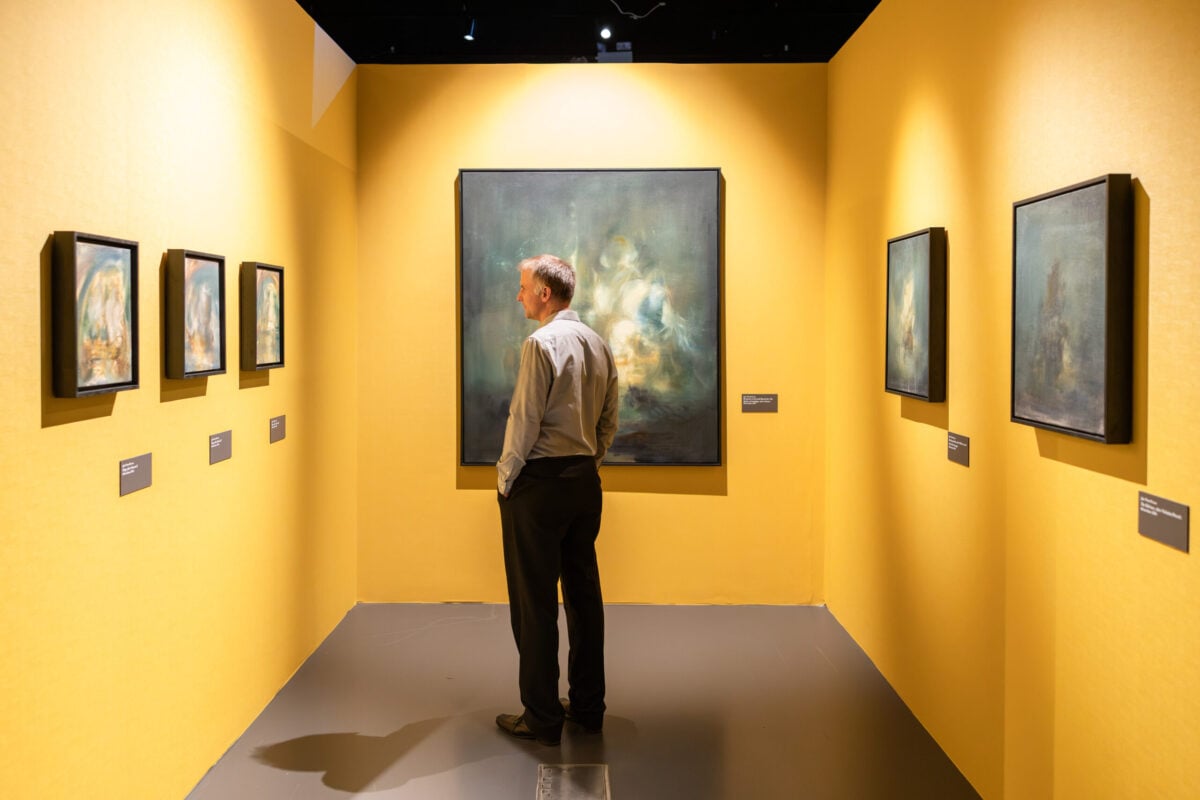
With the opening of the brand-new exhibition “In Turner’s Wake: Contemporary Visions by Jake Wood-Evans,” we take a look at the artist’s enduring connection to the Medway and the influence it had on his career.
Chatham & Rochester
On a visit to the River Medway, Turner sketched Rochester in preparation for a painting. The castle and the cathedral stand proudly in the centre as the river snakes around to the far left, where you can just make out the masts of ships and the buildings of Chatham Dockyard in the distance.
On a later visit, Turner engaged with the detail of the ships being built, fitted-out or repaired at Chatham Dockyard.
In the decades before he visited, the Royal Dockyards had generally become one of the world’s largest and most sophisticated industrial enterprises with a highly skilled workforce.
New buildings at Chatham included a Double Ropehouse, the large Anchor Wharf Storehouses, the Lead and Paint Mill, Royal Dockyard Church and a steam-powered Saw Mill. This was one of Britain’s earliest mechanical saw-mills and the first use of steam power in the yard, where the first stone dry dock was also constructed with a steam-driven dock pump.
For Turner, the Dockyard buildings provided a backdrop to a river that contained an array of wooden walls, masts, spars, blocks, tackle and sail; all the ingredients needed to build – or for an artist to paint – a warship.
The Nation’s Favourite Painting
Turner’s most famous painting, The Fighting Temeraire, has its roots firmly based in Chatham. HMS TEMERAIRE (1798) was laid down at Chatham in July 1793, then commissioned on 21 March 1799 under Captain Peter Puget.
TEMERAIRE fought in the Battle of Trafalgar in 1805, “astern of the Victory”, and engaged with two French ships, REDOUTABLE and FOUGUEUX. Although she defeated both, the ship suffered considerable damage and sustained 47 killed and 76 wounded.
Turner’s oil on canvas painting depicts TEMERAIRE being tugged to be broken up for scrap at the end of her illustrious career and is on permanent display at The National Gallery in London.
About J.M.W Turner
Born in 1775, Turner, the son of a barber, was a child prodigy who entered the Royal Academy Schools at the age of 14 and quickly became one of Britain’s most significant painters. He helped elevate the status of marine and landscape painting, demonstrating that it could engage with historical, religious and literary themes traditionally associated with history painting.
Apart from a brief visit to France in 1802, during the Peace of Amiens, war prevented Turner doing travelling on the Continent- especially to Italy – until after 1815 (when he was 40).
Instead, he travelled extensively round Britain, documenting its landscapes, architecture, coasts and harbours, industries and everyday people of the time. He was fascinated with the maritime world, and very familiar with the River Medway, its towns and estuary.
The sea was a respected historical genre but also represented a topical and patriotic subject for the contemporary art market. Turner always carried sketchbooks, filling many of them with sketches of maritime Britain, its coastline, ports and shipping. These notes and larger studies were the reference material from which he later made finished works in his London studio.